
A Story for Teachers of Adults
Adapted from a story by Ram Das
The train clanked and rattled through the suburbs of Tokyo on this particular afternoon. Our car had a few housewives and their children and some older folks who had been shopping.
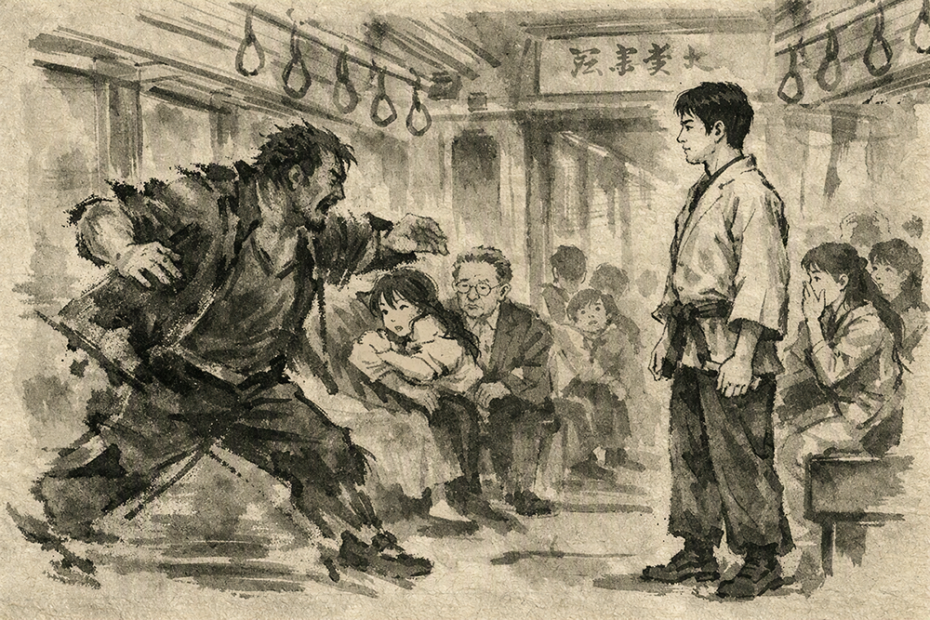
At the next station, the doors opened and suddenly our quiet day was shattered by a man bellowing violent curses. He staggered into our car. He was big, drunk, and dirty. Yelling, he swung at the woman holding a baby. The blow sent her spinning into the laps of an elderly couple.
The passengers were frozen with fear. My aikido teach had said “If you try to dominate people, your are already defeated. We study how to resolve conflict, not how to start it.”
“This is it.” I said to myself as I stood up. “People are in danger. If I don’t do something fast, somebody will probably get hurt.”
Seeing me stand up, the drunk man recognized a chance to focus his rage on me. “Aha” he roared. “A foreigner! You need a lesson in Japanese manners!”
“You are going to get a lesson from me”, he said menacingly. He gathered himself to rush at me.
Before he could move there was an earsplitting “Hey!” The tone was oddly joyous, and limiting as though someone had been searching diligently for this drunken friend and was excited to finally see him.
“Hey!” Everyone in the train car stared at the little Japanese man. This tiny gentleman must have been well into his seventies. He was sitting there immaculate in his kimono. He beamed delightedly at the abusive big man, as though he had a most important, most welcome secret to share.
“C’mere,” the elderly gentleman said, beckoning to the man. “C’mere and talk with me.” He waved his hand invitingly.
The big man planted his feet belligerently in front of the elderly gentleman, and roared, “Why the hell should I talk to you?” The elderly gentleman continued to smile and said,”Whatcha been drinking?”
The big man replied “I’ve been drinking sake and it’s none of your business!”
“Oh that’s wonderful” said the elderly gentleman, “absolutely wonderful. You see I love sake, too. Every night, me and my wife, she’s 76 you know, we warm up a little bottle of sake and take it out into the garden. We sit on an old wooden bench and watch the sun go down. We look to see how our persimmon tree is doing. My great grandfather planted that tree. We worry about whether it will recover from the ice storms we had last winter. Our tree has done better than we expected. When we take our sake outside, we enjoy the evening – even when it rains!” He looked up at the big guy, eyes twinkling.
The drunk man’s face began to soften. His fists slowly unclenched. “Yeah” he said “I love persimmons too.”
“Yes” said the elderly gentleman, “and I’m sure you have a wonderful wife.”
“No” replied the man. “My wife died.” The big man began to sob. “I don’t got no wife. I don’t got no home. I don’t got no job.” Tears rolled down his cheeks and despair seemed to ripple through his entire body.
Just then the train arrived at my stop. As the doors opened, I heard the elderly gentleman say “My my. This is a difficult predicament, indeed. Sit down here and tell me about it.”
As the train pulled away, I sat down on a bench.
It would be a long time before I could speak about the resolution of conflict. We have to listen very carefully for the uniqueness of each individual – including ourselves – for the various levels of our being. Fear and polarization can reflect something that is within us all. Perhaps resolving conflict begins when we are able to see the person before us not as an adversary, but as a human being whose story we have not yet heard.
As Kabir says, we can “do what we do with another human being, but we can never put them out of our heart.”