
By Didi Ananda Sainjana
Kaośikii for Anxiety, Depression, and Emotional Mood Swings Management
Catherine, a mother in her forties, has recently started practising regular meditation with her ishta (personal) mantra. Alongside this, she was also recommended to do three basic asanas daily: the long salutation (diirgha pranam), cobra (bhujangasana), and yoga mudra.
After a few months, she became interested in joining the Kaośikii course, which was offered to anyone who wanted to learn the dance in greater depth and share it with others. Pleased with her newly established yoga and meditation practice, she signed up with the intention of introducing these practices to her neighbourhood and community.
She expected Kaośikii to support her general health and wellness, based on the long list of benefits she had heard about. What she did not expect was the profound and immediate effect the dance had on her mental state.
She never expected it would help her manage anxiety and mood swings. Catherine specifically mentioned that Kaośikii has an immediate effect on her mental state when she practices it: it reliably brings her back into balance, helps her manage her emotions, and boosts her spirit.
She says it can transform the mind from a negative state to hope and joy. She always felt great after doing the dance, and the effects lasted for a long time. She practises once a day, and sometimes twice a day when she is teaching it to her community.
She continues to practise meditation and asanas daily; however, to this day, Kaośikii remains her all-time favourite.
The outcome of teaching the community was also remarkable: children and adults from all walks of life enjoyed the routine she taught them. She continues to teach it and says that “it is a tool for mental clearance and happiness and gives one joy and peace in life”.
Why it works
• Contralateral movements: Strengthen coordination between brain hemispheres and improve emotional regulation.
• Circulation: Increases blood flow, clears brain waves, and lifts mood.
• Gut–brain axis: Decreases gut inflammation, lowers anxiety, and stabilises mood.
• Ideation: A positive mindset; these practices are often used daily to promote mental health, emotional resilience, and personal growth.
About the practice
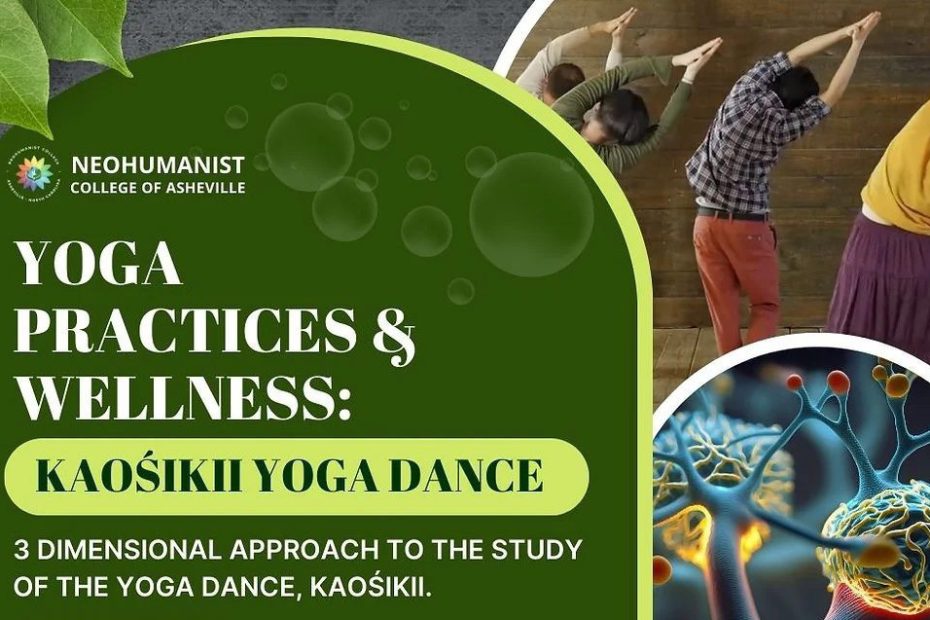
Kaośikii is a mudraic dance. It requires the dancer to move continuously: the contralateral movement of the foot involves tapping the ball of the foot sixteen times, followed by two steps using the entire foot each time, then continuing again for another round. The contralateral movements cross the three planes of movement (frontal, transverse, and sagittal).
Simultaneously, the mantra Bábá Nam Kevalam (“The Expression of Love is all there is”) is repeated, and the ideation of the dance is maintained. With this combination, the dancer focuses on Cosmic Consciousness, expanding the mind and embracing a blissful feeling.
Symbolism (excerpt)
• When the two hands are upraised and folded together: “Now I am trying to establish a link with Parama Puruśa.”
• Both hands bending to the right: “I know the right way to request You.” (The body should bend at a 45° angle.)
• The leftward movement: “I know how to fulfil Your demands.”
• Bending forward: complete surrender.
• Bending backward: “I am ready to face all troubles that may come.”
• The last tá, tá: “O Lord, I repeat Your rhythm.”