
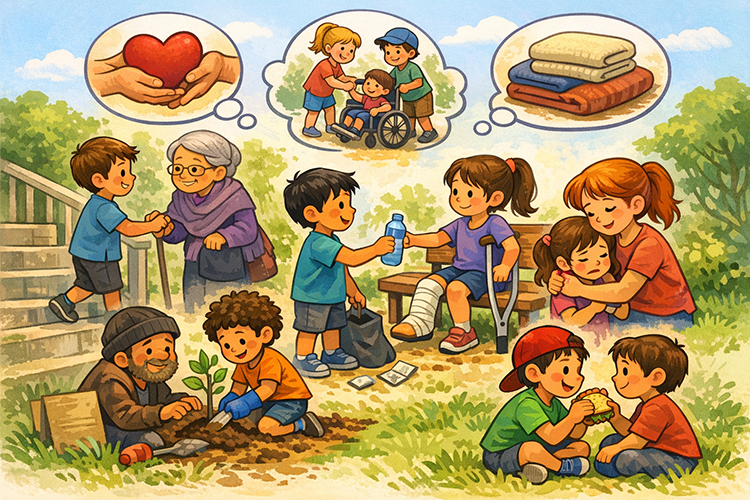
Rendering service and comfort to others freely and increasing this capacity.
I like to help others. I like to help and take care of my friends. What can I do?
Kids and Service
At the earliest age, children are habituated toward feeling compassion, empathy, and sympathy, towards giving. Everyone is born with empathy but the ‘helping’ sizes vary. Caregivers vigilantly watch for and create activities to engage children with helping others so that this joy of serving flourishes and grows. This requires constant nurturing. Young students are encouraged to stretch beyond their own needs and to think of others’ well-being as well.
Children enjoy the appreciation from those who are helped and receive validation as worthy members of the community. Lending a helping hand to other living beings expands the mind – be they peers, plants, insects, animals, or the environment.These activities expand the mind and heart, eliciting a sense of joy. In this way their self-esteem will grow and lightening the burden of others will become a naturally pleasant habit for them.
Supportive Activities
Discussions, and dramas about how to help others give children’s lives meaning and value. Helping others increases the pleasantness of selfless service. Feeding birds, picking up trash, feeding others, making get-well cards, making “I’m sorry” drawings, sending valentines, visiting senior centers, and making gifts for each other. Elementary-aged students are guided to serve and assist others without the expectation of anything in return.Helping others becomes a selfless habit.
Goals
To sacrifice personal comfort to help another.
To volunteer service or comfort without expecting any personal reward (Elementary-aged students).
To make decisions, bearing in mind the well being and peace of others.
To increase awareness of those who are less fortunate and recognize when someone is “in trouble”.
To increase knowledge and practice techniques for giving comfort.
Key Concepts
–Sympathy/Empathy: What makes us sad? How can we help someone who is ‘in trouble’? Why is it important to help others? How can we help someone who is hurting?
–Selflessness: What happens if we don’t help others? How do we feel when we help others?
–Servicemindedness: What can we do to help others? How do we feel when someone helps us?
Helping Others
Children can be helpful when someone is having difficulty taking off their boots, getting dressed, if something has been dropped, if someone has fallen or gets hurt. Instead of waiting for adults to do all the helping. Children are instructed in circumstances when others need help. Concrete examples are reenacted of what it looks like when ‘someone is in trouble’. “Can I take you to a teacher?” Students discuss why it is important for children to help someone. How do you feel when you help?
Affirmations and Verbal Tools for Play & Yoga
–Selflessness: I can help. Baba Nam Kevalam. What can I do? I open my heart to others.
-Sympathy: When I see a friend hurting, I need to help fix them.
- Service: There is someone who needs help. I go out of my way to help. Can I take you to the teacher?
- ‘Helping’ is my super power. I am a SuperFriend.
Support
- Adults plan opportunities to help other individuals and to support wildlife. How can children help a tree or a bird?
- Various discussions are initiated about what ‘well-being’ and ‘happiness’ mean.
- Kids and adults focus on dramatizations regarding the identification of situations of when a friend is ‘in trouble’ and strategies of how kids can support others and give comfort?
- How can we help someone who is sad or physically hurting? What happens if we don’t help others? How can students be co-rescuers with adults when someone is ‘in trouble’
Cooperative Art
~ Children draw/paint landscapes together ~ on a paper mural. A magical creature can be drawn. Everyone adds a few features. A forest scene can be created with trees, a river, and a sky.
~Public Concert ~ Children may go to a nearby park or street corner to sing songs to others, to all of nature for 5-15 minutes.
~Sea-Shell Search ~ In a school setting, older children hide shells around for the younger ones to find. Everyone can only find 2 shells and then sit down. Then the younger ones can do the same for the older students.
Children find joy and meaning when they can place a light in someone’s hand.