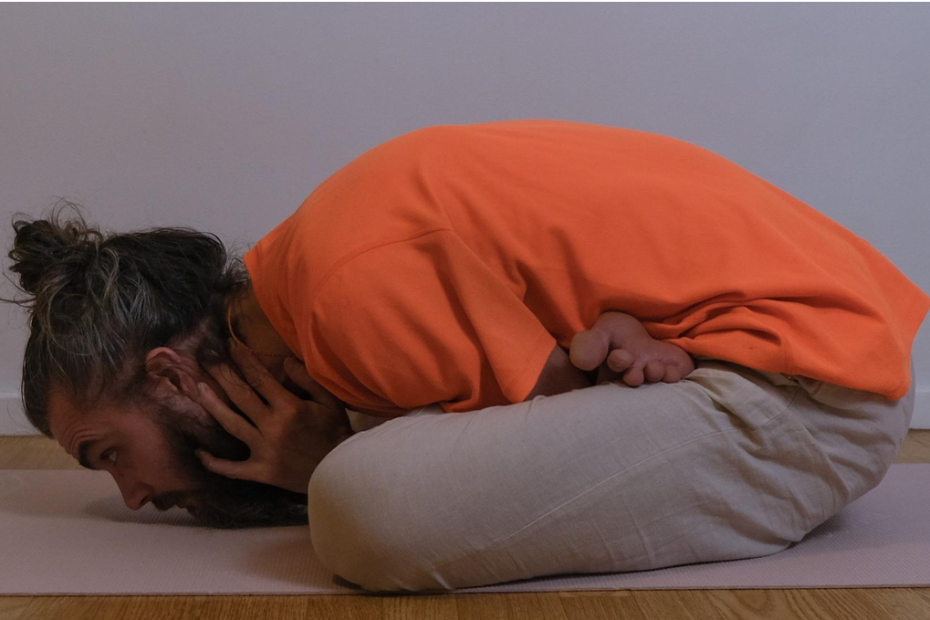
Primary Objective of the Ásana
The Tortoise Posture increases the power of concentration and introspection. Kurkmakásana can expand the limbs. Advanced asana.
For a more detailed description of this pose, please refer to the Ananda Marga Asana Guide which is currently free
Repetitions (standard): 4 times
Length of hold (ideal): 30 seconds
Breath: no kumbhaka, continuous breathing
| Steps of practice | Further details & rationale |
| 1.- Starting from a seated Padmásana posture. | -In practice, many yoga students cannot perform Padmásana, so it will be better and safer to start from a modified Sukhásana (legs may be crossed differently closer to the heels) to avoid pain and/or injury or from a seated cross legged position which has sufficient space between the thighs and calves to insert the arms. |
| 2. – Folding forward, insert both arms through both bent legs and thighs past the elbows. -Let elbows touch the floor. | |
| 3.-Bend the upper torso forward as much as possible. The head is also bent forward. – Place both hands on the neck. -Turn the gaze forward. -There is no breath holding in Kurmakásana. | -The majority of students will not be able to place their hands on the neck. -One can try:- Putting the palms on the top of the head or forehead. -Touching the forehead with the tips of the fingers.-Place a scarf or strap around the neck and hold the ends with the hands, (Short or long depending on your flexibility)-Raising the hands with the tips of the fingers pointing to the forehead, but not touching it -Palms facing upward or facing down and touching the yoga mat. -Use the forearms as a lever to work on active stretching to increase the flexibility needed for this ásana. |
| 4. -Sustain for 30 seconds. Repeat 4 times. -For proper compensation of stretching, one should alternate the crossing of the legs, changing the one that was forward to backward.-Assume a resting position at the conclusion of the practice. | |
Preparatory Steps
- Butterfly stretches, yoga mudra.
- Eka Pada Rajakapotásana/Sleeping pigeon variation.
- Diamond Kurmakásana
I
Variations
- In a seated position bending knees to opposite sides close to the floor and bringing the foot soles together so that the lower limbs are near the floor and in a diamond shape. Then direct the hands between the knees toward the ankles, wrapping the hands around the outside of the ankles. The back is rounded.
- Simple-Making the ‘diamond shape with your legs and the soles of the feet together. Float your hands down the legs to rest on top of the ankles. Back is rounded.
Considerations
Safety essentials
- The body and limbs must be extremely flexible to perform this posture.
Common misalignments
- Take care not to overstretch or strain the limbs.
Benefits
- Strengthens core, lengthens spine, relaxes neck and shoulders.
- Helps concentration and the expansion of the limbs.
- Improves digestive functioning.
Visualizations & Ideations
- I carry my home (0m) with me wherever I go.
- I am connecting with that Inner Sanctuary of Infinite possibilities.
Compensatory & Companion Ásanas
Compensatory: Bhujaungásana/Cobra, Karmásana/Action, Shalabhásana/Locust, Dhanurásana/Bow.