
Our First Line of Defense Yoga for Mental Wellness
Excerpts from the presentation by
Kristine Kaoverii Weber
Master Yoga Trainer & Physical Therapist
Delivered at the symposium on Yoga Therapy for Mental Health
You’ll see if you go on Instagram or Facebook or Tik Tok all these graphics of people saying breathe in for four counts hold for four, breathe out for four, hold for four. That’s going to magically cure your nervous system. You’ll see things like that or or there’s all these breath work certifications that are claiming to do these wonderful things to your nervous system. And so it’s be it’s become very trendy. …We have to be careful about superlative claims.
There’s a a tremendous amount of stress out there externally as well as internally. Having a strong nervous system is really relevant right now and I think being able to share that with our students or the people that you know about these techniques that are tried and true techniques.
Yoga techniques are much older than the fancy breath work stuff that’s out there. They’re much older than medications. They’re much older than any trending sort of nervous system somatic sort of stuff out there. When we can access them and we’re regular about our practices, we can create neuroplastic changes, we can start to feel stronger in ourselves not just from asanas, but from the whole spectrum of practices that we engage in. We do have a sense of resilience as we move forward with this new world and the crises the world is facing.
So the sympathetic part of the nervous system is really important for attention, activity, and movement. It is not the fight-or-flight system. That is a misunderstanding. It is when it’s strongly activated, all of the ganglion are close to the spine. So fortunately, if you’re walking down the street and a car comes whizzing at you, you can jump out of the way. That’s a sympathetic activation. Everything acts very fast, but it’s not always fight-or-flight
Science is very clear, the medical world is very clear that this leads to a whole host of medical conditions. Chronic diseases are often very much correlated with high stress, too much sympathetic activity. Not always, but lots of correlations.
Now on the other side, you have the parasympathetic activity. And by the way, it’s not that sympathetic is bad, it’s the disregulation of it over time that is problematic.
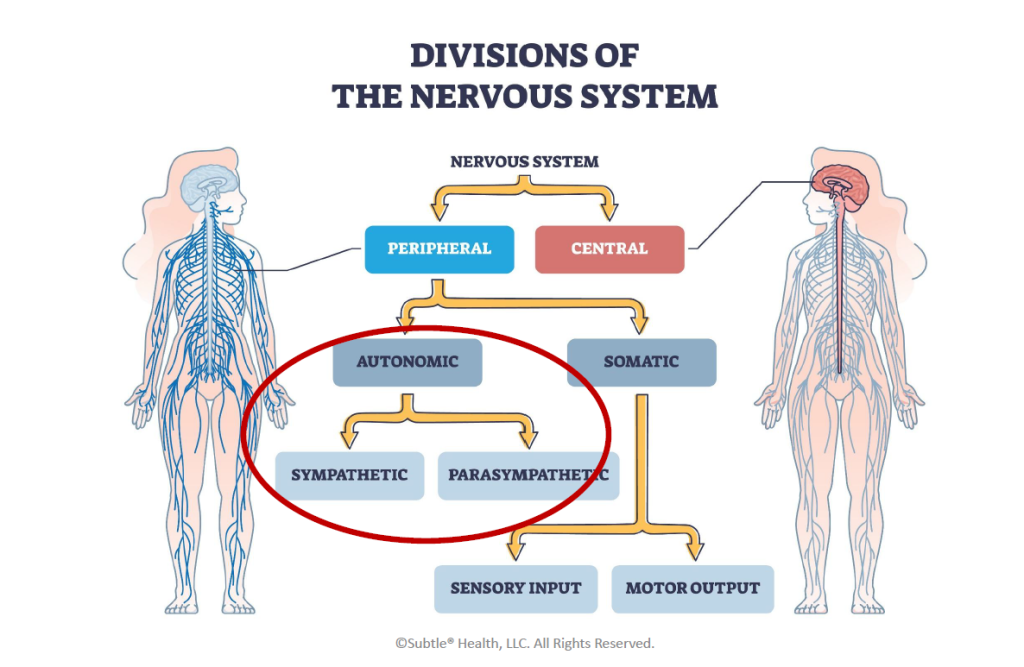
I like to talk about the autonomic dance between the sympathetic and the parasympathetic. You will hear very often people use this inaccurate shortcut that sympathetic is fight-or-flight and parasympathetic is rest-and-digest, but it is reductive. Let me be really frank here. An autonomic nervous system in and of itself is extremely reductive because it is constantly working with all of the other bio systems in the body particularly the neuroendocrine system
I don’t think it’s okay to say fight-or-flight and rest-and-digest because there’s this dance going on all the time. They have to be working together. There’s a spectrum of autonomic activity from rest-and-digest, which is parasympathetic, all the way to fight-or flight, which is sympathetic.
We are throughout the day dancing back and forth on this spectrum.
Starting from the foundation of paying attention to the breath and then mindfully working with it, with asanas and pranayama, this practice becomes very powerful over time to influence the nervous system to start to create neuroplastic changes. How that manifests is a difference in a effect and a difference in mood, a difference in psychology, a difference in mental health. And that’s ultimately what a lot of people need right now.
Yoga may reduce perceived stress, anxiety, depression, and chronic pain. There’s a very robust body of literature of research around the the benefits of yoga for these conditions particularly chronic pain. Yoga has the capacity to start unwinding some of the neuroplasticity of chronic pain so that people are permanently in less pain. The effect of yoga on autonomic flexibility is because of breathing, attentional regulation, movement, interoceptive awareness, which means paying attention to how the body feels and reducing threat reactivity.
Yoga supports nervous system flexibility, autonomic flexibility through multiple pathways. That’s what’s so powerful about it. It’s not just like here is this fantastic breathing practice that you should do that’s going to fix all your problems. It’s here’s this whole spectrum of practices that include physical practices, mental-emotional practices, cognitive, attention-building practices as well as spiritual practices. Again, there’s a the large growing body of research around the benefits of spirituality for health.
How does yoga support nervous system regulation? When somebody has anxiety and high stress and a lot of energy. they need more restoration. They have too much sympathetic tone. They need more restoration, more parasympathetic tone.
It’s typically because there was not enough time for restoration. There was a prolonged period of stress. You see it all the time, right? Somebody, for example, might be working at a very high stress job for years. Then they burn out and they get diagnosed with things like fibromyalgia.
You’re going to start people where they are. I do a lot of contra-lateral movements using opposite hands and feet because that helps the hemispheres of the brain to start communicating a little better. With depression, there’s a lot of asymmetry in the hemispheres and the brain. This may show itself in MRIs. I like trying to create a little more symmetry with a lot of contra-lateral movements, slow movements.
It is important to know where the nervous system is functioning for an individual. We want to nurture the nervous system. Not hit it with a hammer. So, gentle forward bends can be really helpful when you’re trying to start slowly building energy. Then you can shift the focus to the inhale. And I want to make a point here that’s very important. If there’s one thing you hear, shifting the focus to the inhale (or exhale) doesn’t mean breathing longer in and less out. It means you’re having more interoceptive awareness of the mechanics of the inhale. You’re starting to notice that the muscles are moving differently. Observing, paying attention is more important than breathing longer.
Yoga is about building nervous system resilience and capacity over time. Neuroplasticity takes time. If we want to make those changes, we need to practice regularly.
Find out more at subtleyoga.com
The greater the control a person has over the prana, the stronger and more expanded will be (the state of the stability of the mind….
You are taking prana’s help every moment of your daily life….
The receptive power of prana finds scope for expression in a calm mind, with a calm body, and calm organs… -Subhasita Sangraha Part IV, the Chariot and the Charioteer
Anandamurti And Wellness
Shrii Shrii Anandamurti advocated the practice of many physical, mental, emotional, ideational, psychological, and spiritual practices to promote well-being. His teachings on mental health involve the performance of these practices which include asana, breathing, and many others over time to assure wellness. These may need to be combined with other therapies to bring the desired result.
He promoted the idea that the human mind, subtle body, and physical body operate together as a biological and psychic machine, fundamentally influenced by the endocrine system. Mental imbalances, emotional instability, and anxiety are often rooted in the over-secretion or under-secretion of specific glands. He prescribed a specialized regimen of yoga asanas, pranayamas, and a lacto-vegetarian diet to naturally regulate these glands and balance the nervous system. However, there can be other irregularities of the body-mind that may complicate the proper diagnosis.
Anandamurti taught that the root cause of mental suffering is the mind’s tendency to chase finite, limited objects, which yields temporary pleasure instead of lasting peace. His core practice revolves around tantric meditation and raja di raja yoga. Through specific, individualized mantra meditation and ideological practices, practitioners learn to quiet restless energy/Pranendriya and expand the mind to broader neohumanist and universal concepts.
Human psychology under his philosophy recognizes thousands of vrttis (mental propensities, impulses, and emotions such as fear, jealousy, pride, and greed). The goal of yogic mental discipline is not to suppress these tendencies, but to balance the negative tendencies and guide them toward the Supreme. Anandamurti designed a very comprehensive system for wellness and and spiritual elevation.
For instance, practices like the Tandava dance are specifically intended to cultivate courage and dispel deep-seated fears and complexes in the mind. The rhythmic, psycho-spiritual yogic dance Kaoshikii is designed for harmonizing the layers of the mind. The movements help sharpen the mind, improving mental clarity. Kiirtan as practiced in the Ananda Marga tradition is the vocalized chanting of the sacred mantra, Baba Nam Kevalam, while ideating on the Supreme. Defined by Anandamurti as singing the qualities of the Divine out loud, it serves as a powerful method for focusing the mind, opening the heart, and awakening spiritual feelings.
True mental health is achieved when an individual balances internal spiritual development with active, selfless service to the world community. Virtually all Ananda Marga spiritual practices lead to that Goal of self regulation and becoming One with the Infinite when practiced whole heartedly with regularity over time.
Train yourself in the ideal of the lily, which blossoms in the mud and has to keep itself engaged in the struggle for existence day in and day out, parrying, bracing, and fighting the shocks of muddy water and storms and squalls and sundry other vicissitudes of fortune, and yet it does not forget the moon above. It keeps its love for the moon constantly alive. It seems, however, but a most ordinary flower. There is nothing extraordinary about it. Still, this most ordinary flower has a romantic tie with the great moon. Similarly, you may be an ordinary creature – you may have to pass your days in the ups and downs of your worldly existence – still do not forget that Supreme One. Keep all your desires inclined towards Him. Always keep yourselves merged in His thought. Go deep into the mood of that Infinite Love. – Subhasita Sangraha III